Abasia-Astasia
Medical Terms That Are Not Made Up #1

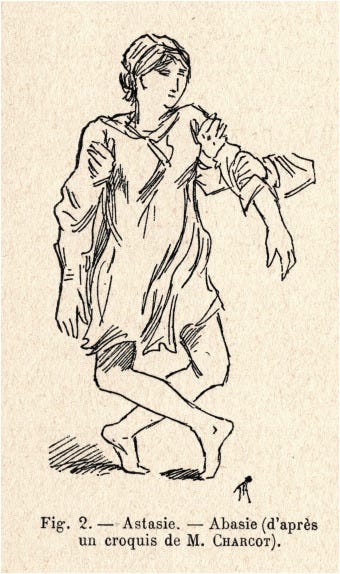
I love medicine. One of the most fun ways to learn is something I never considered before. Read the consultants’ notes. Not only do you get to see how they view each problem, but they also have a different ‘dialect’ of medicine. Recently, I was reading a neurologist's note who used the term abasia-astasia. I stopped reading the note and stared at this bizarre medical rhyme. This feels like I stumbled upon the neuro version of tomato, tomato (you said it different in your head, right? :D).
Of course, I had to look it up afterwards and briefly entered into a medical history rabbit hole. The term is based on the Greek astasis and basis for ‘instability’ and ‘the action of walking’, respectively. Currently, the term refers to an inability to stand and walk despite normal motor function when seated or laying down. Now the history of this term has a legendary lineup of former doctors tied to it. Are you ready?
The term was first coined in 1888 by Paul Blocq who was a resident of Jean-Martin Charcot. Charcot is a well-known French neurologist who is commonly remembered today for conditions like Charcot foot, a foot deformity common in late-stage diabetes, and Charcot’s triad, which is used to assess for an inflamed bile duct (and is still highly specific at 93.2% based on a 2017 meta-analysis). The cause and accepted terminology were debated over the next century and have been described as a functional ataxia, hysterical paraplegia, and even a localised electrification. At one point in 1916, Dr. Georges Guillain and Alexander Barre reported on this during a medical meeting of the 6th Army. Later in the 1920’s during separate gatherings of the Paris Neurological Society, Jean Lhermitte and Joseph Babinski (another former resident of Charcot) had presented further research and understanding to this phenomena. The highlighted names above should be familiar to those in medicine. Guillain-Barre syndrome. Lhermitte’s test. Babinski Sign. However, countless doctors were part of this 100 plus year effort to reach our current understanding and I encourage you to read more about them in the article below.
Hopefully you enjoy a little medical history as much as I do. Thanks for reading the first installment of Medical Terms That Are Not Made Up (MTTANMU for ‘short’). Until next time!
Sources:
O. Walusinski, From hysteria to gait dementia: History of the concept of astasia-abasia, Revue Neurologique, Volume 179, Issue 6, 2023, Pages 523-532, ISSN 0035-3787, https://doi.org/10.1016/j.neurol.2022.12.012. https://www.sciencedirect.com/science/article/pii/S0035378723009177)
Rumsey S, Winders J, MacCormick AD. Diagnostic accuracy of Charcot's triad: a systematic review. ANZ J Surg. 2017 Apr;87(4):232-238. doi: 10.1111/ans.13907. Epub 2017 Feb 17. PMID: 28213923.